-
Current status and short-term results regarding frailty in patients undergoing gastrointestinal cancer resection in Japan: a retrospective cohort study
-
Asuka Yasueda
 , Junichi Nishimura, Seiji Ikeda, Naotsugu Haraguchi, Hirofumi Akita, Hiroshi Wada, Chu Matsuda, Takeshi Omori, Masayoshi Yasui, Hironari Tamiya, Hideaki Tahara, Hiroshi Miyata , Junichi Nishimura, Seiji Ikeda, Naotsugu Haraguchi, Hirofumi Akita, Hiroshi Wada, Chu Matsuda, Takeshi Omori, Masayoshi Yasui, Hironari Tamiya, Hideaki Tahara, Hiroshi Miyata
-
Ann Clin Nutr Metab 2026;18(1):54-62. Published online March 30, 2026
-
DOI: https://doi.org/10.15747/ACNM.25.0013
-
-
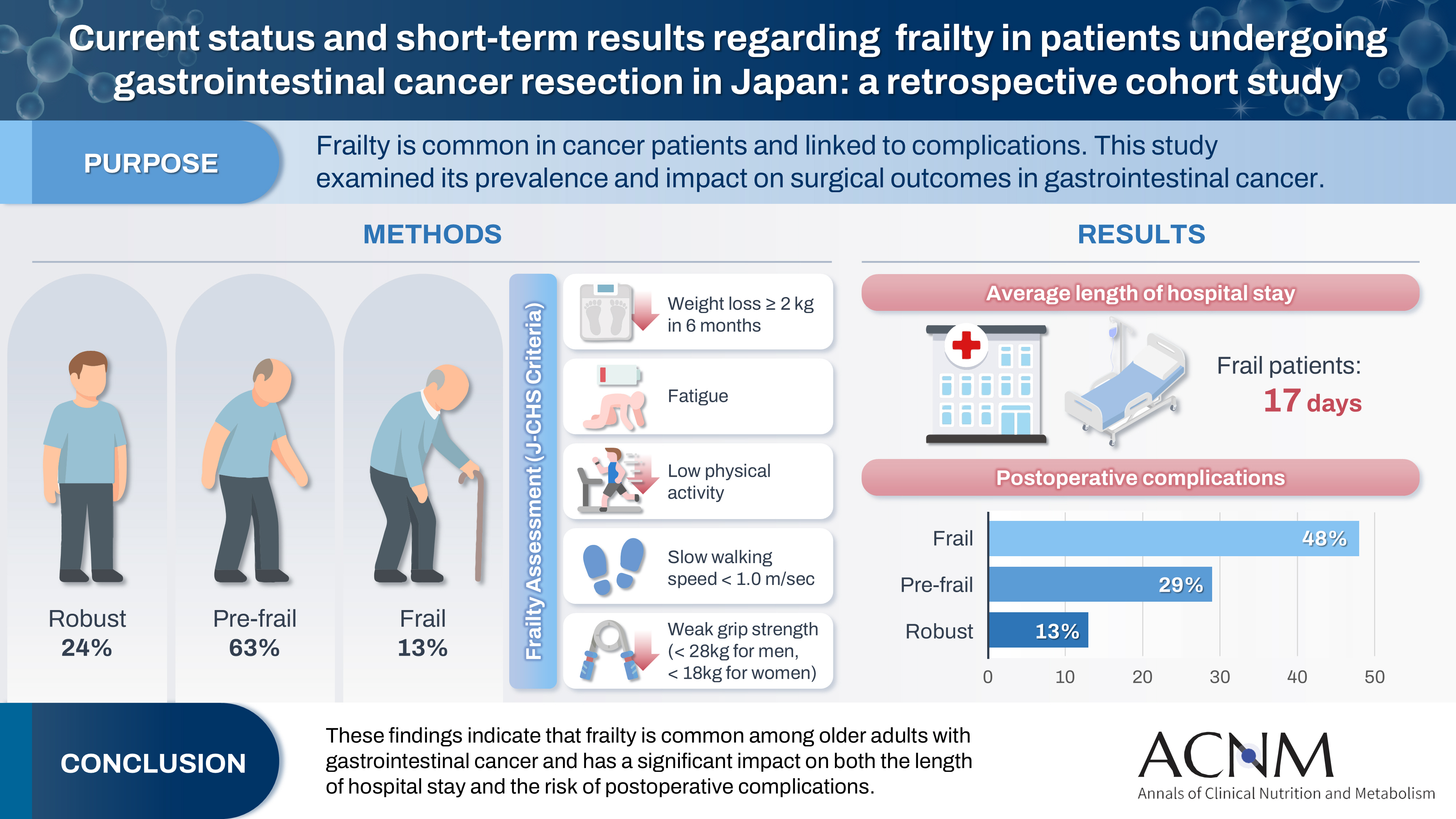
 Graphical Abstract Graphical Abstract
 Abstract Abstract
 PDF PDF
 - Purpose
Frailty is a state of physical and cognitive decline that exists between robust health and the need for nursing care. Frailty is reported to occur at a high rate among patients with cancer and is associated with postoperative complications, such as delirium, infection, reduced survival, and rehospitalization. In this study, we investigated the incidence of frailty and surgical outcomes in patients who underwent surgery for gastrointestinal cancer.
Methods
A total of 201 patients who underwent preoperative physical assessment at Osaka International Cancer Institute between July and September 2021 were included. The Japanese version of the Cardiovascular Health Study (J-CHS) index was used to assess the frequency of frailty and related postoperative outcomes.
Results
Among the 201 patients, 27 (13%) were classified as frail and 126 (63%) as pre-frail. Of the 27 frail patients, 22 (81%) were older adults—a significantly higher proportion compared to the pre-frail/robust group (P=0.004). The median hospital stay for frail patients was 17 days (range, 5–98 days), which was significantly longer than that for robust patients (P<0.001). Postoperative complications occurred in 13 frail patients (48%), which was higher than in pre-frail (n=36, 29%) and robust (n=6, 13%) patients. Furthermore, multivariate analysis showed that frailty was an independent risk factor for postoperative complications.
Conclusion
These findings indicate that frailty is common among older adults with gastrointestinal cancer and has a significant impact on both the length of hospital stay and the risk of postoperative complications.
-
Postoperative nutritional outcomes after robot-assisted versus open pancreaticoduodenectomy: a retrospective cohort study
-
Takahiro Shimaoka, Kazuki Sasaki, Shogo Kobayashi, Shinichiro Hasegawa, Daisaku Yamada, Yoshito Tomimaru, Hirofumi Akita, Takehiro Noda, Hidenori Takahashi, Yuichiro Doki, Hidetoshi Eguchi
-
Published online September 11, 2026
-
DOI: https://doi.org/10.15747/ACNM.26.0069
-
-
Abstract
- Purpose
Robot-assisted pancreaticoduodenectomy (RPD) may enable precise surgical manipulation, but its association with postoperative nutritional recovery remains unclear. We compared short-term surgical and nutritional outcomes between RPD and open pancreaticoduodenectomy (OPD).
Methods
We retrospectively reviewed patients who underwent pancreaticoduodenectomy at our institution from January 2017 to December 2023 and compared outcomes between RPD and OPD.
Results
Fifty-seven patients were included (RPD, n=23; OPD, n=34). Compared with OPD, RPD was associated with longer operative time (550 [492–597] vs. 445 [412–521] minutes; P<0.01) but lower blood loss (20 [10–135] vs. 490 [298–848] mL; P<0.01). Major complications (4.3% vs. 35.3%; P<0.01) and clinically relevant postoperative pancreatic fistula (4.3% vs. 32.4%; P=0.02) were less frequent after RPD, and hospital stay was shorter (19 [15–23] vs. 32 [22–39] days; P<0.01). The Prognostic Nutritional Index (PNI) was higher after RPD on postoperative day 7 (35.4 [34.7–36.8] vs. 32.1 [29.9–35.5]; P=0.01), but not on day 14 (37.3 [34.6–40.8] vs. 35.1 [33.8–37.5]; P=0.06). PNI recovery rates were similar between groups.
Conclusion
Among selected patients with noninvasive or low-grade pancreatic pathology, RPD was associated with favorable short-term surgical outcomes and higher PNI on postoperative day 7. However, PNI on day 14 and PNI recovery rates did not differ significantly. Given the retrospective, nonrandomized design and small sample size, these findings do not establish a causal effect of RPD on nutritional recovery.
|
 E-submission
 KSPEN
KSPEN KSSMN
KSSMN ASSMN
ASSMN JSSMN
JSSMN