
 E-submission
 KSPEN
KSPEN KSSMN
KSSMN ASSMN
ASSMN JSSMN
JSSMNIndexed in:
Scopus, KCI, KoreaMed
Scopus, KCI, KoreaMed

Search
- Page Path
- HOME > Search
Original Articles
- Association of soy oil-based lipid injectable emulsion with early body weight loss after minimally invasive esophagectomy in Japan: a retrospective cohort study
-
Tomonori Narita
 , Kazuhiko Fukatsu, Kenichi Kono, Satoshi Murakoshi, Reo Inoue, Midori Noguchi, Nana Matsumoto, Shoh Yajima, Koichi Yagi, Yoshifumi Baba
 - Ann Clin Nutr Metab 2026;18(1):34-43. Published online March 30, 2026
- DOI: https://doi.org/10.15747/ACNM.25.0030
-
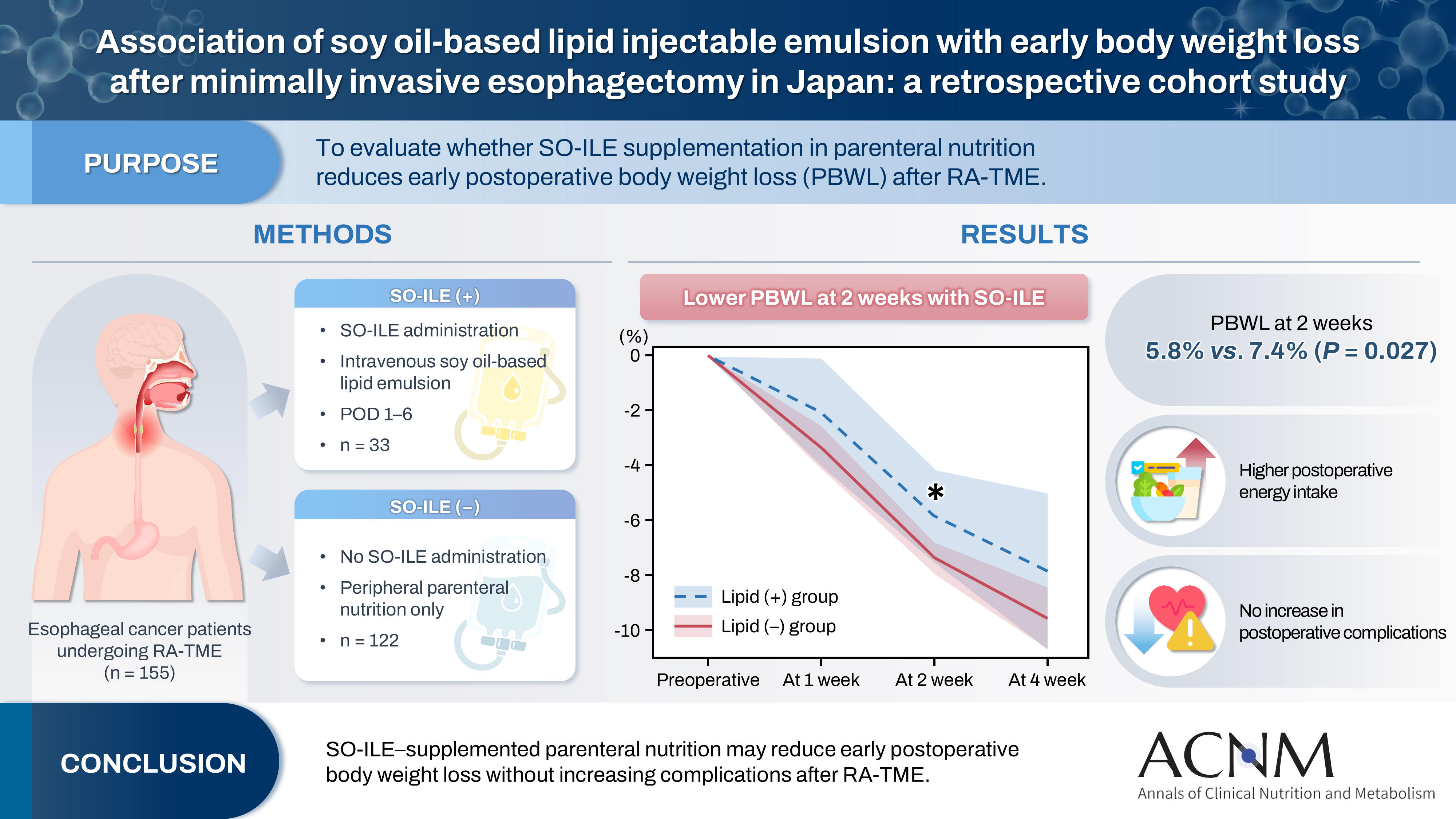
 Graphical Abstract
 Abstract
 PDF
PDF Supplementary Material
 - Purpose
Postoperative body weight loss (PBWL) is associated with poor long-term outcomes following esophagectomy for esophageal cancer, underscoring the critical importance of perioperative nutritional management. Although minimally invasive procedures, such as robot-assisted radical transmediastinal esophagectomy (RA-TME), have become increasingly prevalent, perioperative nutritional strategies have received comparatively limited attention. This study evaluated the impact of soy oil-based injectable lipid emulsion (SO-ILE) on PBWL in patients undergoing RA-TME.
Methods
We retrospectively analyzed 155 patients who underwent RA-TME for esophageal or esophagogastric junction cancer at our hospital between 2011 and 2022. Patients were divided into two groups: the lipid (+) group (n=33), which received SO-ILE between postoperative days 1 and 6, and the lipid (–) group (n=122), which did not receive SO-ILE. Oral or enteral nutrition was withheld until postoperative day 6. Nutrient intake, postoperative outcomes, and nutritional status were compared between the two groups.
Results
Patient backgrounds, surgical outcomes, and postoperative complication rates were similar between the two groups. However, patients in the lipid (+) group received significantly greater total energy and nutrient intake. PBWL at 2 weeks after surgery was significantly lower in the lipid (+) group than in the lipid (–) group (5.8% vs. 7.4%; P=0.027). Univariate analysis showed that absence of SO-ILE administration was the only significant risk factor for PBWL greater than 5% at 2 weeks after RA-TME (P=0.038).
Conclusion
SO-ILE may have the potential to mitigate early PBWL after RA-TME.
- 2,180 View
- 23 Download

- Impact of tube feeding after pancreaticoduodenectomy on nutritional intake and status: a retrospective cohort study in Japan
-
Masaharu Ishida, Masahiro Iseki, Shuichiro Hayashi, Aya Noguchi, Hideaki Sato, Shingo Yoshimachi, Akiko Kusaka, Mitsuhiro Shimura, Shuichi Aoki, Daisuke Douchi, Takayuki Miura, Shimpei Maeda, Masamichi Mizuma, Kei Nakagawa, Takashi Kamei, Michiaki Unno
- Ann Clin Nutr Metab 2025;17(3):203-209. Published online December 1, 2025
- DOI: https://doi.org/10.15747/ACNM.25.0020

-
Graphical Abstract
Abstract
PDF
- Purpose
Pancreaticoduodenectomy (PD) is one of the most invasive procedures in gastrointestinal surgery. However, the clinical significance of postoperative tube feeding remains unclear. This study investigated the impact of enteral nutrition (EN) on the postoperative nutritional status of patients undergoing PD.
Methods
We retrospectively analyzed 129 patients who underwent PD at Tohoku University Hospital. Nutritional intake and status, evaluated using the Controlling Nutritional Status score, were compared between two groups: an EN group (97 patients) and a non-EN group (32 patients).
Results
There were no significant differences between the two groups in age, sex, body mass index, underlying diseases, operative duration, blood loss, postoperative pancreatic fistula, postoperative complications, delayed gastric emptying, or length of hospital stay. Although the EN group showed improvements in nutritional status both at discharge and compared with preoperative values, none of these changes reached statistical significance. Oral caloric intake was significantly higher in the non-EN group (P=0.01). In contrast, total energy intake was higher in the EN group, but this difference did not reach statistical significance (P=0.07).
Conclusion
Tube feeding after PD did not significantly influence postoperative nutritional status or overall nutritional intake. These findings suggest that EN offers no clear advantage over other approaches; however, further research is warranted to validate these results, refine existing guidelines, and optimize postoperative patient management.
- 2,001 View
- 24 Download
- Characteristics and Clinical Course of Patients Who Received Enteral or Parenteral Nutrition in Tertiary Referral Hospitals in Korea
- Eunmi Seol, Yun-Suhk Suh, Dal Lae Ju, Hye Jung Bae, Hyuk-Joon Lee
- J Clin Nutr 2016;8(2):58-65. Published online August 31, 2016
- DOI: https://doi.org/10.15747/jcn.2016.8.2.58
-
Abstract
PDF
Purpose:
The purposes of this study are to evaluate clinical characteristics of malnourished patients who received nutritional therapy and to compare their clinical courses according to nutritional support team (NST) consultation in tertiary referral hospital in Korea.
Methods:
From June 2014 to May 2015, 43,954 admitted patients who were more than 18 years old were retrospectively investigated. Characteristics of patients who received enteral nutrition (EN) or parenteral nutrition (PN) for more than 3 days (nutritional therapy group) were compared to the patients without nutritional therapy (control group). In addition, clinical courses according to NST consultation (NST group and non-NST group) were compared through propensity score matching (PSM).
Results:
EN or PN was applied in 4,599 patients for more than 3 days (nutritional therapy group: 10.5%). For characteristics, there were significant differences between two groups (nutritional therapy group
vs. control group) with age, male proportion, body weight, body mass index. All laboratory data at admission were significantly worse in nutritional therapy group. And for clinical courses, there were significant differences in length of stay (LOS), rate of intensive care unit (ICU) admission, LOS in ICU, Acute Physiology and Chronic Health Enquiry (APACHE II) score, days of nutritional therapy, mortality rate. NST consultation was made in 39% of nutritional therapy group. Among departments, Thoracic Surgery showed the highest rate of NST consultation (68.5%) otherwise Neurosurgery showed the lowest rate (18.7%). When PSM between NST groupvs. non-NST group were made, significant differences was shown only in the rate of ICU admission, EN or PN support days, cholesterol at discharge.Conclusion:
In tertiary referral hospital in Korea, more than 10% of patients still needed active nutritional therapy. NST consultation rate varies among departments. We failed to find significant differences between NST group and non-NST group.
-
Citations
Citations to this article as recorded by
- Early nutritional support for inpatients reduces admission rates to intensive care units in Korea: a single-center case-control study
Hyun Suk Kim, Jae Do Yang, Se Wung Han, Mi Rin Lee, Da-Sol Kim, Sejin Lee, Seon-Hyeong Kim, Chan-Young Kim
Annals of Clinical Nutrition and Metabolism.2024; 16(2): 57. CrossRef - Report on the Current Trend of Commercial Enteral/Parenteral Nutrition in Outpatient
Hyun Ji Lee, Hyo Jung Park, Seon Young Chung, Myung Sook Min, Ok Soon Jeong, Ja Kyung Min
Journal of Korean Society of Health-System Pharmacists.2023; 40(2): 211. CrossRef - Nutritional Status of Intensive Care Unit Patients According to the Referral to the Nutrition Support Team and Compliance with the Recommendations
Yunjin Sohn, Taisun Hyun
Korean Journal of Community Nutrition.2022; 27(2): 121. CrossRef - Physician Compliance with Nutrition Support Team Recommendations: Effects on the Outcome of Treatment for Critically Ill Patients
Hyon-Ju Yon, Eun-Suk Oh, Ji Young Jang, Ji Yun Jang, Hongjin Shim
Journal of Acute Care Surgery.2022; 12(1): 1. CrossRef - Path Analysis for Delirium on Patient Prognosis in Intensive Care Units
Sunhee Lee, Sun-Mi Lee
Journal of Korean Academy of Nursing.2019; 49(6): 724. CrossRef
- Early nutritional support for inpatients reduces admission rates to intensive care units in Korea: a single-center case-control study
- 2,214 View
- 4 Download
- 5 Crossref
 First
First Prev
Prev


