
 E-submission
 KSPEN
KSPEN KSSMN
KSSMN ASSMN
ASSMN JSSMN
JSSMNIndexed in:
Scopus, KCI, KoreaMed
Scopus, KCI, KoreaMed

Search
- Page Path
- HOME > Search
Original Articles
- Association between vitamin D deficiency and psychological distress in Korean adults: a population-based cross-sectional study
-
Minyoung Baek
 , Jiyoung Jung, Hyojung Kang, Hyunah Kim
 - Ann Clin Nutr Metab 2026;18(2):145-153. Published online July 31, 2026
- DOI: https://doi.org/10.15747/ACNM.26.0047
-
 Graphical Abstract
 Abstract
 PDF
PDF Supplementary Material
 - Purpose
Vitamin D deficiency is prevalent in Korea, but evidence on its association with psychological distress remains limited. This study examined the association between vitamin D levels and psychological distress, depression, and anxiety, among Korean adults.
Methods
This cross-sectional study included 4,712 adults aged ≥19 years from the 2022 KNHANES. Participants were classified as vitamin D-deficient (<20 ng/mL) or non-deficient (≥20 ng/mL) groups. Psychological distress, depression, and anxiety were assessed using the Patient Health Questionnaire-9 and Generalized Anxiety Disorder-7. Multivariable logistic regression was used to estimate adjusted odds ratios for these outcomes according to vitamin D status.
Results
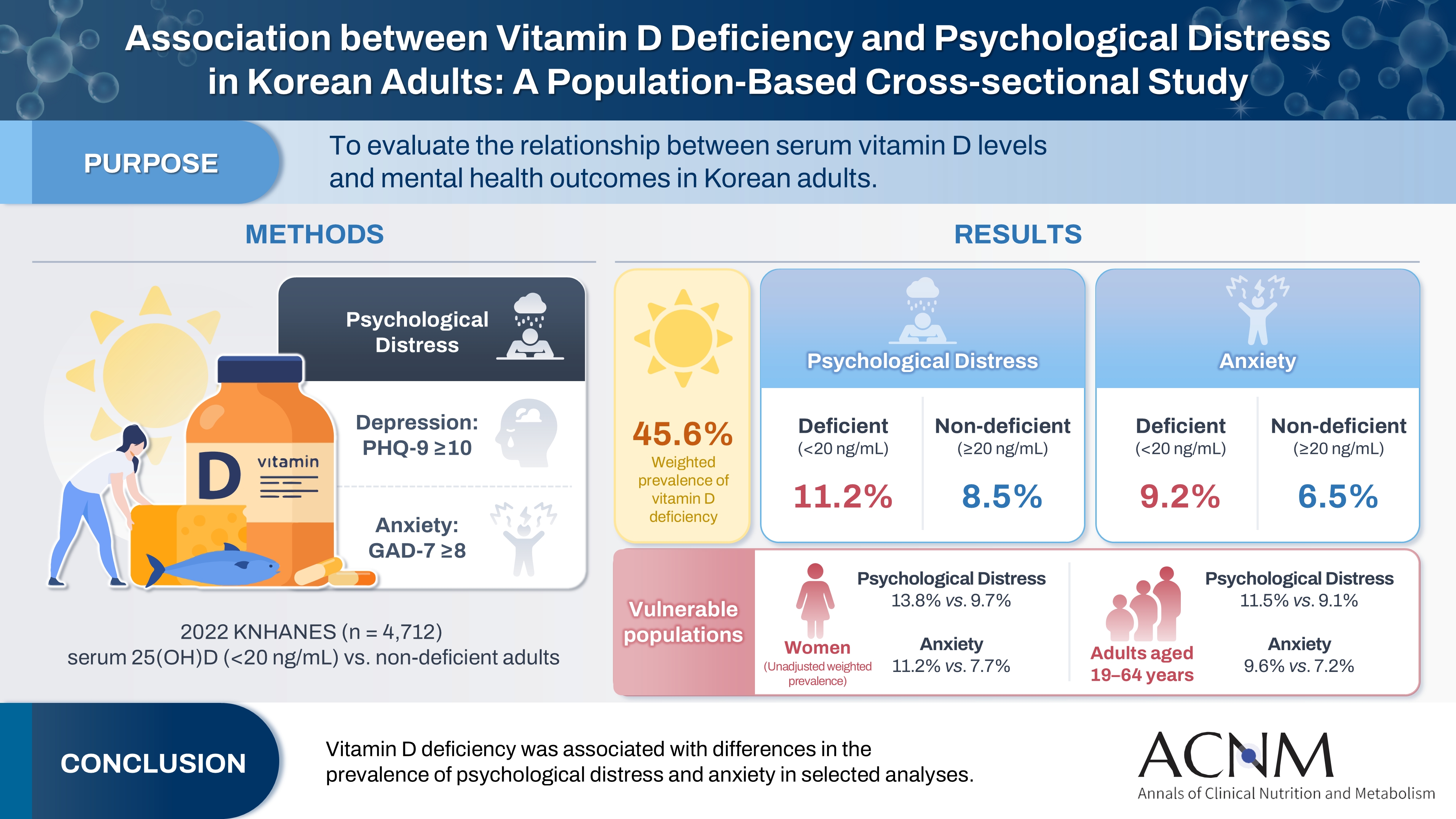
The weighted prevalence of vitamin D deficiency was 45.6%. Unadjusted analyses showed higher prevalences of psychological distress (11.2% vs. 8.5%; P=0.004) and anxiety (9.2% vs. 6.5%; P=0.005) in the deficient group, especially among women and adults aged 19–64 years. After adjustment, the associations were attenuated and not statistically significant in the total population. In age-stratified models, vitamin D deficiency remained significantly associated with psychological distress in adults aged 19–64 years and ≥65 years and with anxiety in adults aged 19–64 years.
Conclusion
Although psychological distress was more prevalent in the vitamin D-deficient group before adjustment, the association was not statistically significant after covariate adjustment in the total population. Subgroup analyses showed higher unadjusted prevalences of psychological distress and anxiety among women with vitamin D deficiency. Adjusted models showed significant associations with psychological distress in both age groups. These findings suggest potential subgroup-specific associations, warranting longitudinal studies to confirm causality.
- 857 View
- 16 Download

- Micronutrient deficiencies in copper, zinc, and vitamin D as predictors of clinical outcomes in critically ill surgical patients in Korea: a retrospective cohort study
-
Jiae Kim, Yanghee Jun, Ye Rim Chang, Jong-Kwan Baek, Hak-Jae Lee, Hyewon Han, Suk-Kyung Hong
- Ann Clin Nutr Metab 2024;16(3):158-167. Published online December 1, 2024
- DOI: https://doi.org/10.15747/ACNM.2024.16.3.158
-
Abstract
PDF
- Purpose: To investigate the prevalence of copper, zinc, and vitamin D deficiencies in surgical intensive care unit (SICU) patients and the associations between those deficiencies and clinical outcomes.
Methods: We conducted a retrospective study of 210 patients admitted to the SICU of Asan Medical Center between June 2020 and June 2022. Micronutrient levels were measured within 7 days of SICU admission. Primary outcomes were the mortality rate, length of SICU stay, hospital stay duration, and mechanical ventilation duration.
Results: Copper deficiency was found in 35% (68/193), zinc deficiency in 52% (100/193), and severe vitamin D deficiency in 46% (82/179) of patients. Copper-deficient patients showed a significantly higher mortality rate (25.0% vs. 12.8%, P=0.044), longer hospital stays (57.8±47.0 vs. 45.2±36.6 days, P=0.041), and extended mechanical ventilation duration (26.9±23.3 vs. 18.8±15.7 days, P=0.012). Zinc deficiency was associated with higher C-reactive protein levels (16.2±9.5 vs. 11.5±8.8 mg/dL, P=0.001) and lower prealbumin levels (6.5±2.8 vs. 9.9±5.6 mg/dL, P<0.001). Severe vitamin D deficiency (<10 ng/mL) was not significantly associated with mortality or other clinical outcomes (mortality: <10 ng/mL vs. ≥10 ng/mL, 13% vs. 18%, P=0.583).
Conclusion: Micronutrient deficiencies are prevalent in SICU patients. Copper deficiency significantly correlated with poor clinical outcomes, and zinc deficiency showed a strong association with inflammatory markers. Early assessment and supplementation of micronutrients could be beneficial for critically ill surgical patients.
- 10,768 View
- 98 Download
Review Article
- Vitamin D Deficiency in Critically Ill Patients
- Ji Hyun Lee, Jae-Myeong Lee
- Surg Metab Nutr 2017;8(2):17-22. Published online December 30, 2017
- DOI: https://doi.org/10.18858/smn.2017.8.2.17
-
Abstract
PDF
Vitamin D deficiency is a commonly observed global phenomenon in both the general population as well as hospitalized patients, especially critically ill patients. Many studies have demonstrated an association between vitamin D deficiency and risk of chronic diseases, including cardiovascular disease, diabetes, cancers, autoimmune diseases, and infectious diseases. Vitamin D deficiency is also associated with multiple adverse health outcomes, including increased morbidity and mortality in critically ill patients. The purpose of this review article is to present the current knowledge of clinical outcomes as well as the positive and adverse effects of vitamin D supplements on the relationship between vitamin D status and critical illness. In addition, future strategies for dealing with vitamin D deficiency are suggested.
- 4,185 View
- 7 Download
 First
First Prev
Prev


