-
Postoperative nausea and vomiting after emergent abdominal surgery in trauma patients in Korea: a multicenter retrospective observational study
-
Doo-Hun Kim
 , Hoonsung Park, Heejin Kim, Jihyeon Ahn, Mina Choi, Dae-Sang Lee, Tae Hwa Hong, Hang Joo Cho, Maru Kim , Hoonsung Park, Heejin Kim, Jihyeon Ahn, Mina Choi, Dae-Sang Lee, Tae Hwa Hong, Hang Joo Cho, Maru Kim
-
Ann Clin Nutr Metab 2026;18(2):138-144. Published online July 31, 2026
-
DOI: https://doi.org/10.15747/ACNM.26.0044
-
-
 Graphical Abstract Graphical Abstract
 Abstract Abstract
 PDF PDF
 - Purpose
The present study aimed to assess the incidence and risk factors of postoperative nausea and vomiting (PONV) after emergency abdominal surgery in trauma patients.
Methods
This retrospective observational study included trauma patients who underwent emergency abdominal surgery at two trauma centers between January 2024 and May 2025. Medical records were reviewed according to the occurrence of PONV.
Results
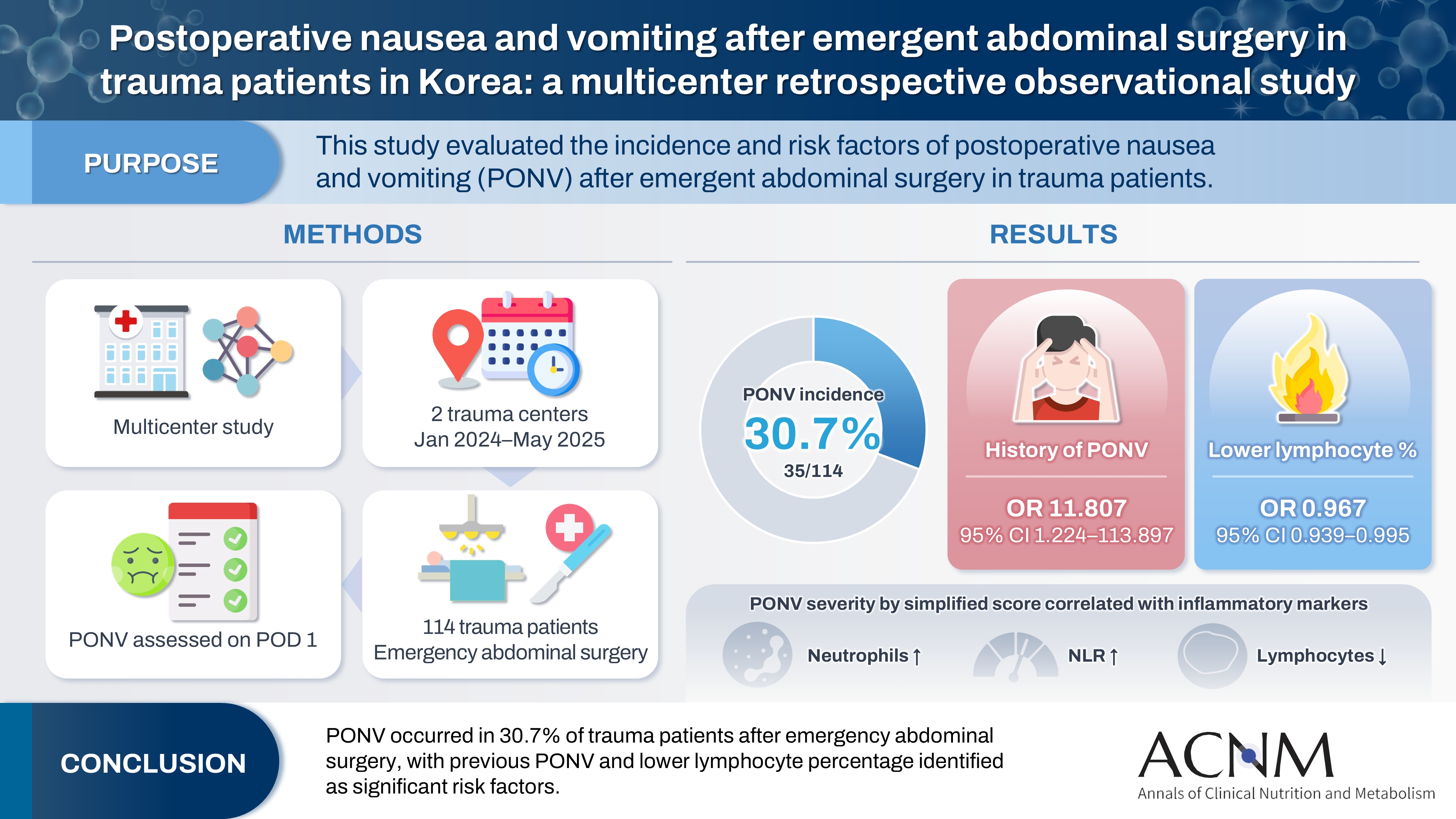
A total of 114 patients were included in the analysis, of whom 35 patients (30.7%) developed PONV. Patients with a history of PONV had a higher incidence of PONV than those without such a history (80% vs. 28.4%; P=0.030). The lymphocyte percentage was lower in the PONV group (27.8% vs. 20.0%; P=0.023). In binary logistic regression analysis, previous PONV (B=2.469, P=0.033; odds ratio [OR], 11.807; 95% confidence interval [CI], 1.224–113.897) and lymphocyte percentage (B=−0.034, P=0.021; OR, 0.967; 95% CI, 0.939–0.995) were significant risk factors. PONV severity was also associated with a higher segmented neutrophil percentage, a higher neutrophil-to-lymphocyte ratio, and a lower lymphocyte percentage.
Conclusion
The incidence of PONV was 30.7%. Previous PONV and a lower lymphocyte percentage were identified as risk factors for PONV after emergency abdominal surgery in trauma patients. Further studies are needed to develop strategies for reducing PONV in this population.
-
Analysis of Muscle Using CT Anthropometry in Major Trauma Patients
-
Hang Joo Cho, Yunsup Hwang, Yoon Hyun Lee, Dae Hyun Cho, Dae-Sang Lee, Maru Kim
-
Surg Metab Nutr 2020;11(1):12-15. Published online June 30, 2020
-
DOI: https://doi.org/10.18858/smn.2020.11.1.12
-
-
Abstract
PDF
- Purpose: The feasibility of nutritional assessment using computed tomography anthropometry has been previously proven. The abdominal muscle at the L3 vertebra is a well-known nutritional biomarker for predicting the prognosis of various diseases, and especially sarcopenia. However, any studies on nutritional assessment of the brain, face, or neck via computed tomography are still scarce. We retrospectively investigated the applicability of the masseter muscle as a nutritional biomarker.
Materials and Methods: Patients who underwent simultaneous brain and abdominopelvic computed tomography at a regional trauma center were retrospectively analyzed. Their masseter muscles at 2 cm below the zygomatic arch and abdominal muscle at L3 were assessed via computed tomography anthropometry. Basic clinical data including trauma information was also reviewed. The data was analyzed in conjunction with the patients’ mortality.
Results: A total of 411 patients were analyzed in the study (316 men and 95 women, mean age: 50.41 years, mean areas of the masseter and abdominal muscles: 10.6 and 137.3 cm2, respectively) and there 146 major trauma patients with an injury severity score higher than 15. The masseter muscle area was decreased in the mortality group of major trauma patients (10.4 vs 7.9 cm2, P=0.001). However, abdominal muscles did not show statistical significance (137.9 vs. 117.7 cm2, P=0.054).
Conclusion: The masseter muscle, when analyzed via computed tomography anthropometry, showed a statistical association with patients’ mortality and it could prove its feasibility as a nutritional biomarker.
|
 E-submission
 KSPEN
KSPEN KSSMN
KSSMN ASSMN
ASSMN JSSMN
JSSMN