-
Postoperative nausea and vomiting after emergent abdominal surgery in trauma patients in Korea: a multicenter retrospective observational study
-
Doo-Hun Kim
 , Hoonsung Park, Heejin Kim, Jihyeon Ahn, Mina Choi, Dae-Sang Lee, Tae Hwa Hong, Hang Joo Cho, Maru Kim , Hoonsung Park, Heejin Kim, Jihyeon Ahn, Mina Choi, Dae-Sang Lee, Tae Hwa Hong, Hang Joo Cho, Maru Kim
-
Ann Clin Nutr Metab 2026;18(2):138-144. Published online July 31, 2026
-
DOI: https://doi.org/10.15747/ACNM.26.0044
-
-
 Graphical Abstract Graphical Abstract
 Abstract Abstract
 PDF PDF
 - Purpose
The present study aimed to assess the incidence and risk factors of postoperative nausea and vomiting (PONV) after emergency abdominal surgery in trauma patients.
Methods
This retrospective observational study included trauma patients who underwent emergency abdominal surgery at two trauma centers between January 2024 and May 2025. Medical records were reviewed according to the occurrence of PONV.
Results
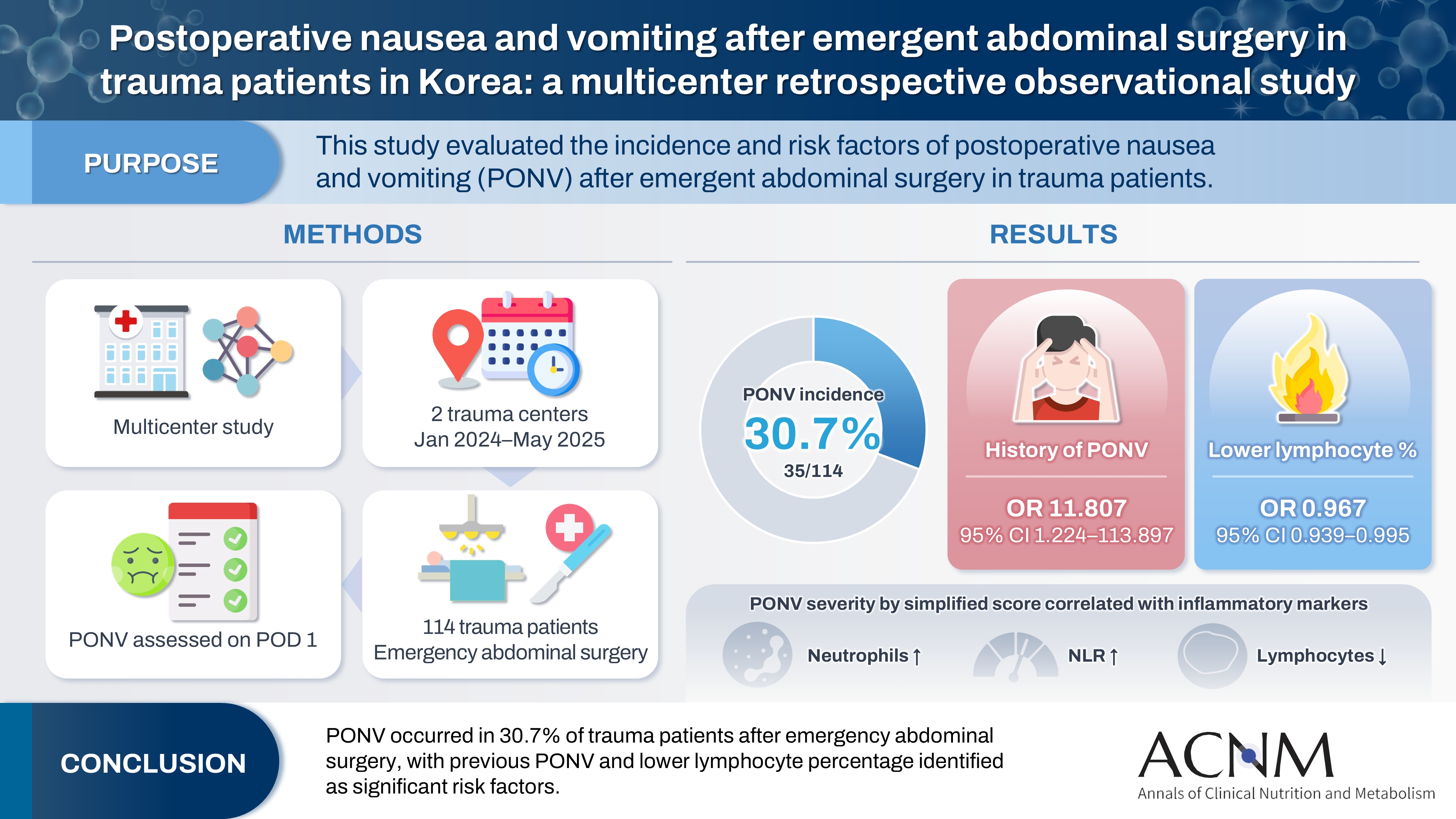
A total of 114 patients were included in the analysis, of whom 35 patients (30.7%) developed PONV. Patients with a history of PONV had a higher incidence of PONV than those without such a history (80% vs. 28.4%; P=0.030). The lymphocyte percentage was lower in the PONV group (27.8% vs. 20.0%; P=0.023). In binary logistic regression analysis, previous PONV (B=2.469, P=0.033; odds ratio [OR], 11.807; 95% confidence interval [CI], 1.224–113.897) and lymphocyte percentage (B=−0.034, P=0.021; OR, 0.967; 95% CI, 0.939–0.995) were significant risk factors. PONV severity was also associated with a higher segmented neutrophil percentage, a higher neutrophil-to-lymphocyte ratio, and a lower lymphocyte percentage.
Conclusion
The incidence of PONV was 30.7%. Previous PONV and a lower lymphocyte percentage were identified as risk factors for PONV after emergency abdominal surgery in trauma patients. Further studies are needed to develop strategies for reducing PONV in this population.
-
Sequential Changes in Body Composition Using Bioelectrical Analysis during the Metabolic Response in Critically Ill Surgical Patients
-
Seok Rae Park, Seung Hwan Lee, Kyung Sik Kim, Hosun Lee, Tae Hwa Hong, Jae Gil Lee
-
Surg Metab Nutr 2017;8(1):13-16. Published online June 30, 2017
-
DOI: https://doi.org/10.18858/smn.2017.8.1.13
-
-
Abstract
PDF
-
Purpose: Assessment of sequential changes in body composition during the metabolic response in critically ill surgical patients is essential for optimal nutritional support and management. Bioelectrical impedance analysis (BIA) is an easy, portable, and quick way to assess body composition. Thus, the aim of this study was to evaluate the sequential changes in body composition and the validity of Direct segmental Multi-frequency BIA in critically ill surgical patients. Materials and Methods: Twenty-three patients admitted to the intensive care unit (ICU) after major surgery were measured for body composition by multiple-frequency BIA after intensive care unit admission as well as 3 and 7 days later. Repeated-measures analysis of variance (ANOVA) was used to detect significant changes over time. Results: The average length of intensive care unit stay was 4.3 days. Total body water, extracellular water, skeletal muscle mass (SMM), soft lean mass, and fat-free mass (FFM) increased during the first 72 h of intensive care unit admission, after which they decreased slightly. On the other hand, fat mass decreased during the first 72 h of intensive care and then increased. However, arm circumference (AC), arm muscle circumference (AMC), and waist circumference (WC) gradually decreased by day 7 (P<0.001). Conclusion: In this study, AC, AMC, WC, and direct segmental Multi-frequency BIA were less affected by initial resuscitation in the intensive care unit (ICU). Therefore, segmental BIA may be useful for critical ill patients in altered hydration states.
-
Citations
Citations to this article as recorded by  - Predicting outcomes of continuous renal replacement therapy using body composition monitoring: a deep-learning approach
Kyung Don Yoo, Junhyug Noh, Wonho Bae, Jung Nam An, Hyung Jung Oh, Harin Rhee, Eun Young Seong, Seon Ha Baek, Shin Young Ahn, Jang-Hee Cho, Dong Ki Kim, Dong-Ryeol Ryu, Sejoong Kim, Chun Soo Lim, Jung Pyo Lee, Sung Gyun Kim, Gang Jee Ko, Jung Tak Park, Ta
Scientific Reports.2023;[Epub] CrossRef
-
2,153
View
-
2
Download
-
1
Crossref
|
 E-submission
 KSPEN
KSPEN KSSMN
KSSMN ASSMN
ASSMN JSSMN
JSSMN