
 E-submission
 KSPEN
KSPEN KSSMN
KSSMN ASSMN
ASSMN JSSMN
JSSMNIndexed in:
Scopus, KCI, KoreaMed
Scopus, KCI, KoreaMed

Search
- Page Path
- HOME > Search
Guideline
- Nutritional support for critically ill patients by the Korean Society for Parenteral and Enteral Nutrition—part II: a clinical practice guideline
-
Jae Gil Lee
 , You Min Sohn, Seung Hwan Lee, Yun Tae Jung, Hak-Jae Lee, Jeong Yun Park, Nak-Jun Choi, Jung Mi Song, Jee Young Lee, Ji Yeon Kim, Ji Yeong Jeong, Ye Won Sung, Eun Jeong Park, Hyun Ji Ko, Ji Yoon Cho, Bomi Kim, Yesung Oh, In Chung Lee, Jin Young Lee, A Ram Kim, Jee Yeon Lee, Seong-Eun Kim, Tae Sun Ha, Min Kwan Kwon
 - Ann Clin Nutr Metab 2026;18(2):65-116. Published online July 31, 2026
- DOI: https://doi.org/10.15747/ACNM.26.0059
-
 Abstract
 PDF
PDF Supplementary Material
 - Purpose
Nutritional therapy is an essential component of intensive care management. Appropriate nutritional support may reduce infectious and metabolic complications and promote recovery in critically ill patients. However, nutritional practices vary across institutions, and international guidelines may not be directly applicable to clinical practice in Korea. Evidence-based clinical practice guidelines that reflect Korean intensive care unit practice are therefore needed.
Methods
The Korean Society for Parenteral and Enteral Nutrition developed these clinical practice guidelines for nutritional therapy in critically ill adults through a systematic literature review and multidisciplinary expert consensus.
Results
In total, 24 key clinical questions and 59 recommendations were developed. The guidelines address enteral and parenteral nutrition, feeding intolerance, aspiration prevention, energy and protein assessment, immune-modulating nutrition, micronutrient supplementation, refeeding syndrome, and disease-specific nutritional therapy for critically ill adults, including those with acute kidney injury, acute liver failure, acute respiratory distress syndrome, sepsis, trauma, and obesity. The recommendations emphasize individualized nutritional therapy according to hemodynamic status, metabolic phase, organ dysfunction, nutritional risk, and treatment goals.
Conclusion
These guidelines provide practical, evidence-based recommendations for nutritional therapy in critically ill adults and reflect both current international evidence and Korean clinical practice. They may support more standardized and consistent nutritional support in Korean intensive care units.
- 2,648 View
- 72 Download

Original Articles
- Association of early parenteral energy provision with serum phosphorus decline and phosphorus-based refeeding syndrome in critically ill patients with liver cirrhosis: a Korean retrospective observational study
-
Jee Young Lee, Yeo Kon Kye, Kwang Il Seo, Kyung Won Seo, Sooyong Lee, Jesang Yu
- Ann Clin Nutr Metab 2026;18(2):162-172. Published online July 31, 2026
- DOI: https://doi.org/10.15747/ACNM.26.0055
-
 Graphical Abstract
Abstract
PDF
Graphical Abstract
Abstract
PDF - Purpose
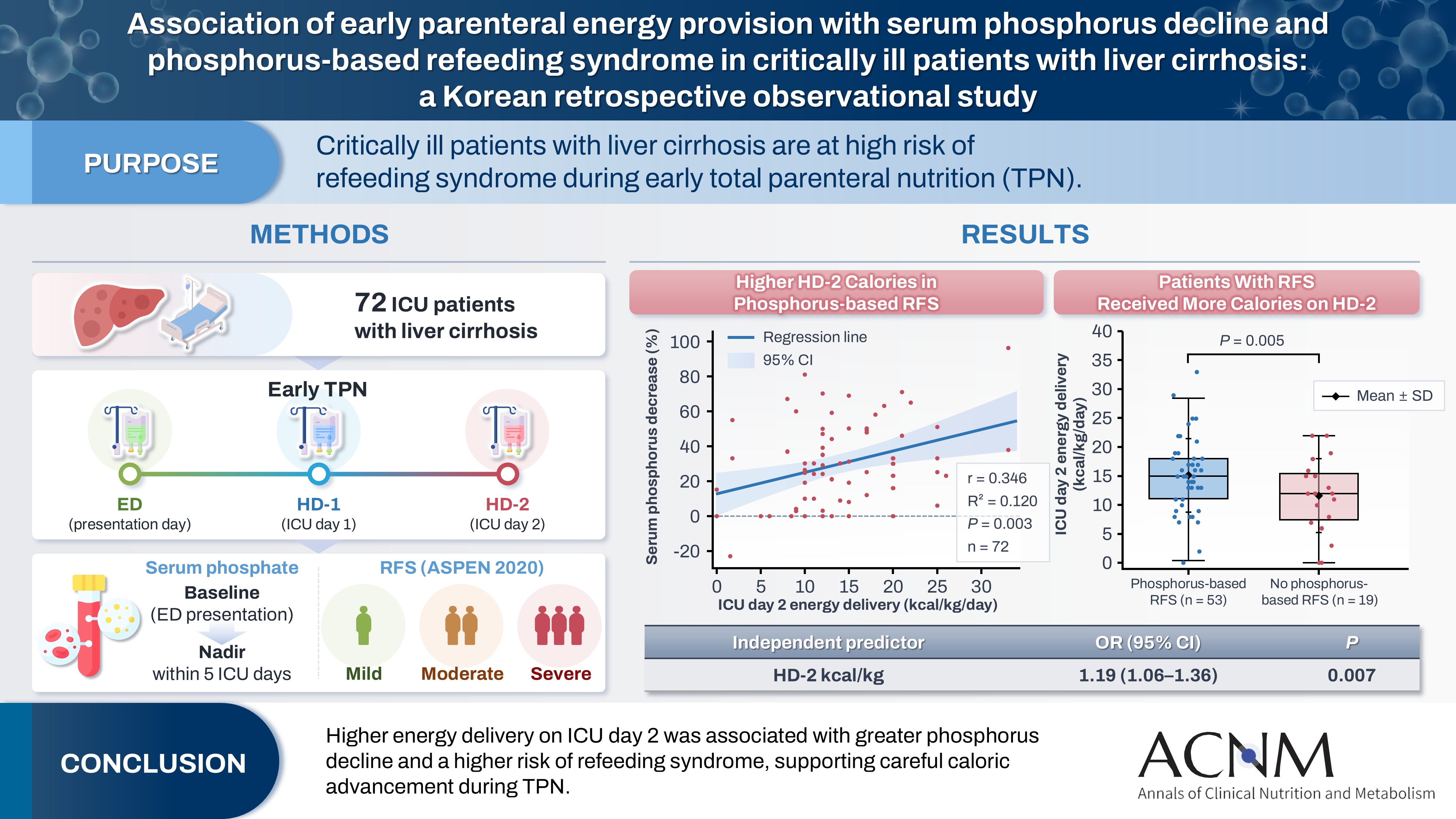
Critically ill patients with liver cirrhosis are vulnerable to malnutrition and refeeding-related electrolyte disturbances, particularly with rapid caloric advancement. As hypophosphatemia is a key feature of refeeding syndrome (RFS) and phosphorus homeostasis may be impaired in cirrhosis, the association of early parenteral energy provision with serum phosphorus decline and RFS was evaluated in cirrhotic ICU patients.
Methods
This retrospective study included 72 adults with liver cirrhosis admitted to a tertiary intensive care unit (ICU) between January 2021 and August 2024. Parenteral energy intake was assessed at emergency department (ED) and on ICU days 1 and 2. Serum phosphorus reduction was defined as the percentage decrease from baseline to the nadir within 5 ICU days. Phosphorus-based RFS was defined per the 2020 ASPEN consensus as a ≥10% phosphorus decrease after reinitiating or increasing energy provision, graded as mild, moderate, or severe.
Results
Phosphorus-based RFS occurred in 53 patients (73.6%), including severe RFS in 35 (48.6%). ICU day 2 caloric intake per body weight correlated with phosphorus reduction (r=0.346, P=0.003) and was independently associated with greater decline (P=0.011) and with meeting RFS criteria (odds ratio, 1.19; 95% CI, 1.06–1.36; P=0.007), along with ED glucose load (P=0.001). ROC analysis showed modest discrimination (AUC 0.7061; cutoff, 10.92 kcal/kg/day).
Conclusion
Higher caloric delivery on ICU day 2 was associated with greater phosphorus decline and RFS in cirrhotic ICU patients. These exploratory associations do not establish causality, and the cutoff requires external validation. Monitoring caloric delivery and serial electrolytes may support safer parenteral nutrition.
- 1,323 View
- 19 Download
- Preprocedural prognostic nutritional index predicts early gastrointestinal symptoms after percutaneous endoscopic gastrostomy or percutaneous radiologic gastrostomy in Korea: a retrospective cohort study
-
Yoonhong Kim, Jee Young Lee, Yeajin Moon, Seung Hun Lee, Kyung Won Seo, Ki Hyun Kim
- Ann Clin Nutr Metab 2025;17(3):196-202. Published online December 1, 2025
- DOI: https://doi.org/10.15747/ACNM.25.0032
-
Graphical Abstract
Abstract
PDF
- Purpose
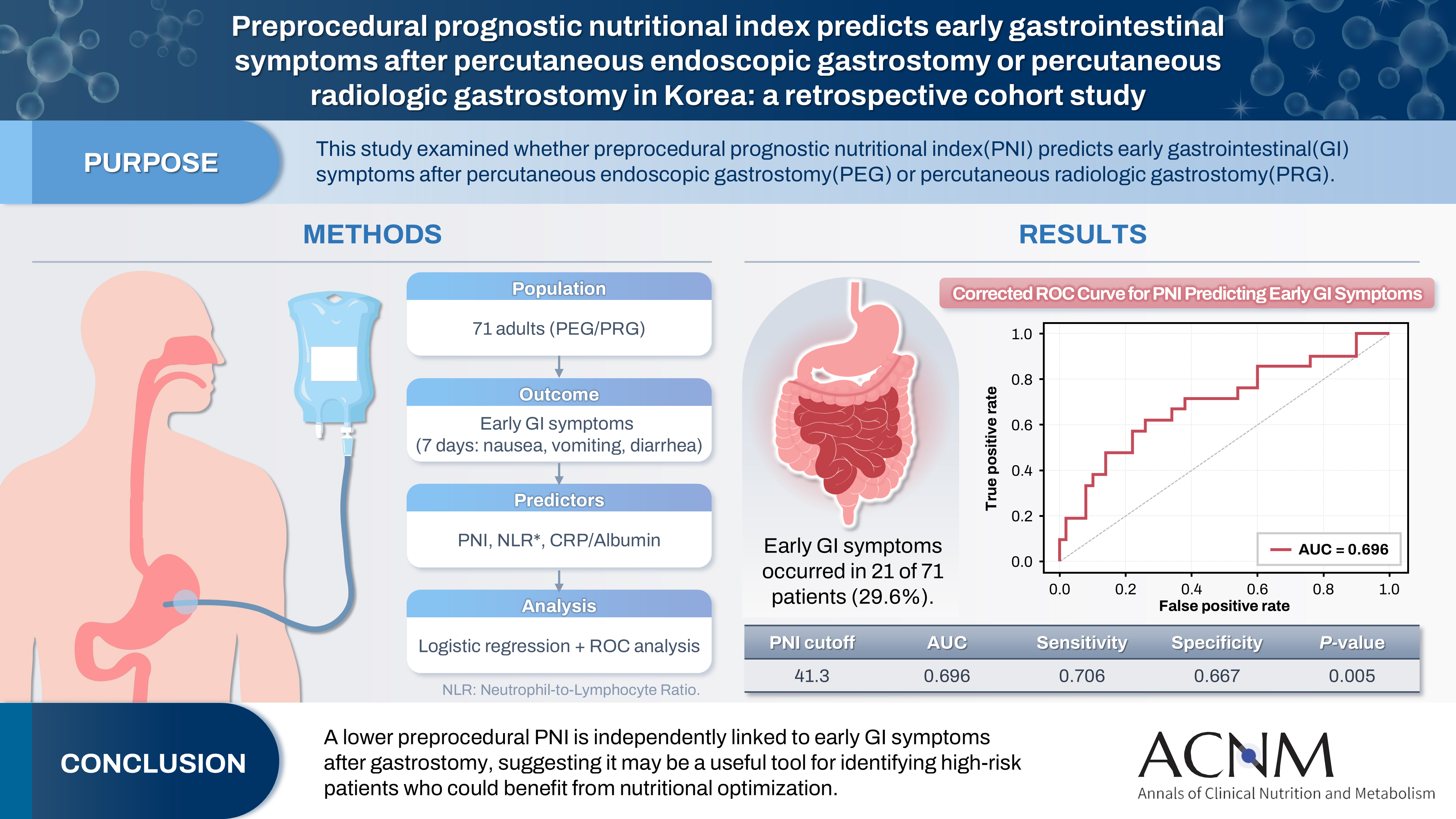
The prognostic nutritional index (PNI) reflects immunonutritional status and is a well-established predictor of surgical outcomes. Although its association with post-gastrostomy mortality has been documented, its relationship with early gastrointestinal (GI) symptoms remains unclear. This study aimed to evaluate whether the preprocedural PNI predicts early GI symptoms following percutaneous gastrostomy, including percutaneous endoscopic gastrostomy (PEG) and percutaneous radiologic gastrostomy (PRG).
Methods
This retrospective study included 71 adults who underwent PEG or PRG. Early GI symptoms, such as nausea, vomiting, and diarrhea, occurring within 7 days were recorded. The preprocedural PNI, neutrophil-to-lymphocyte ratio (NLR), and the C-reactive protein (CRP)-to-albumin ratio were analyzed using logistic regression to identify predictors. Receiver operating characteristic (ROC) analysis was performed to assess the PNI’s discriminative performance.
Results
Early GI symptoms occurred in 21 of 71 patients (29.6%). In univariate analysis, the PNI (P=0.009) and CRP-to-albumin ratio (P=0.018) were significant predictors, whereas NLR was not (P=0.125). After adjustment for potential confounders, including age, sex, body mass index, and NLR, the PNI remained an independent predictor of early GI symptoms (adjusted odds ratio, 0.90; 95% confidence interval, 0.83–0.98; P=0.021). ROC analysis for the PNI produced an area under the curve of 0.696, with an optimal cutoff value of 41.3 (sensitivity 70.6%, specificity 66.7%).
Conclusion
A lower preprocedural PNI is independently associated with the development of early GI symptoms after gastrostomy. The PNI may serve as a practical screening tool to identify high-risk patients who could benefit from preemptive nutritional optimization. -
Citations
Citations to this article as recorded by
- Comment on “impact of percutaneous endoscopic gastrostomy (PEG) timing on mortality in intensive care unit patients: The modifying role of the prognostic nutritional index (PNI)”
M. Ganesan, K. Suresh Babu, K. Srinivasa Galu, Ponazhagan
Clinical Nutrition ESPEN.2026; 74: 103361. CrossRef
- Comment on “impact of percutaneous endoscopic gastrostomy (PEG) timing on mortality in intensive care unit patients: The modifying role of the prognostic nutritional index (PNI)”
- 2,361 View
- 31 Download
- 1 Crossref
Guideline
- Nutritional support for critically ill patients by the Korean Society for Parenteral and Enteral Nutrition — part I: a clinical practice guideline
-
Seung Hwan Lee, Jae Gil Lee, Min Kwan Kwon, Jiyeon Kim, Mina Kim, Jeongyun Park, Jee Young Lee, Ye Won Sung, Bomi Kim, Seong Eun Kim, Ji Yoon Cho, A Young Lim, In Gyu Kwon, Miyoung Choi, KSPEN Guideline Committee
- Ann Clin Nutr Metab 2024;16(3):89-111. Published online December 1, 2024
- DOI: https://doi.org/10.15747/ACNM.2024.16.3.89
-
Abstract
PDFSupplementary Material
- Purpose: Nutritional support for adult critically ill patients is essential due to the high risk of malnutrition, which can lead to severe complications. This paper aims to develop evidence-based guidelines to optimize nutritional support in intensive care units (ICUs).
Methods: The Grading Recommendations, Assessment, Development and Evaluation process was used to develop and summarize the evidence on which the recommendations were based. Clinical outcomes were assessed for seven key questions.
Results: We recommend the following: (1) initiate enteral nutrition (EN) within 48 hours after treatment as it is associated with improved outcomes, including reduced infection rates and shorter ICU stays; (2) early EN is preferred over early parenteral nutrition due to better clinical outcomes; (3) the use of supplementary parenteral nutrition to meet energy targets during the first week of ICU admission in patients receiving early EN is conditionally recommended based on patient-specific needs; (4) limited caloric support should be supplied to prevent overfeeding and related complications, particularly in the early phase of critical illness; (5) higher protein intake is suggested to improve clinical outcomes, such as muscle preservation and overall recovery; (6) additional enteral or parenteral glutamine is conditionally recommended against due to the lack of significant benefit and potential harm; and (7) fish oil-containing lipid emulsions is conditionally recommended due to their potential to enhance clinical outcomes, including reduced infection rates and shorter ICU stays.
Conclusion: These evidence-based recommendations can improve clinical outcomes and support healthcare providers in making informed decisions about nutritional interventions in the ICU. -
Citations
Citations to this article as recorded by- Case Report: Optimizing wound care: tailored nutritional strategies with immune- modulating enteral nutrients
Fiji Antony, Wafaa Ayesh
Frontiers in Nutrition.2026;[Epub] CrossRef - Actualización en terapia médica nutricional del paciente críticamente enfermo: avances, desafíos y evidencia reciente
Nestor David Caicedo-Buitrago, Mateo Londoño-Pereira, Claudia Milena Ardila Melendez, Ricardo Merchán, Fernando Pereira-Paternina, Cristian Pinilla, Sonia Gamboa, Alejandra Cabral, Janeth Barbosa Barbosa, Maria del Pilar Morales, Bladimir Gil
Acta Colombiana de Cuidado Intensivo.2026; 26(3): 100612. CrossRef - Rationale for Determining Energy Requirement in Hospitalized Patients: A Narrative Review
Suk-Kyung Hong, Kyung Mo Kim
Pediatric Gastroenterology, Hepatology & Nutrition.2026; 29(3): 212. CrossRef - Early supplemental parenteral nutrition and risk of subsequent enteroatmospheric fistula in high-risk open abdomen patients with persistent enteral nutrition intolerance: a landmark propensity score-matched cohort study
Wenyue Wang, Tian Xie, Chen Chen, Fen Chen, Dongliang Yang, Pengfei Wang, Yousheng Li
Frontiers in Medicine.2026;[Epub] CrossRef - Development of a multidisciplinary cooperative nutrition management process for critically ill patients—a Delphi expert consensus study
Shunxia Sun, Jin Yang, Juan Huang, Jiangqiong Peng, Xiaoling Tang
Frontiers in Nutrition.2026;[Epub] CrossRef - Individualizing post-ICU nutrition: from guideline intent to bedside practice
Oona Leemans, Zenzi Rosseel, Claude Pichard, Dan Waitzberg, Lee-anne S. Chapple, Krista Haines, Lu Ke, Paul Wischmeyer, Arthur R.H. van Zanten, Elisabeth De Waele
Current Opinion in Critical Care.2026;[Epub] CrossRef - Nutritional support for critically ill patients by the Korean Society for Parenteral and Enteral Nutrition—part II: a clinical practice guideline
Jae Gil Lee, You Min Sohn, Seung Hwan Lee, Yun Tae Jung, Hak-Jae Lee, Jeong Yun Park, Nak-Jun Choi, Jung Mi Song, Jee Young Lee, Ji Yeon Kim, Ji Yeong Jeong, Ye Won Sung, Eun Jeong Park, Hyun Ji Ko, Ji Yoon Cho, Bomi Kim, Yesung Oh, In Chung Lee, Jin Youn
Ann Clin Nutr Metab.2026; 18(2): 65. CrossRef - Nutrition management in critically ill surgical patients: a clinical practice guideline appraisal and synthesis
Chen Xin, Yuhong Luo, Yuhua Liu, Yan Xu, Guixin Liu, Binru Han, Frances Lin
Clinical Nutrition.2026; 65: 106755. CrossRef - Enteral Nutrition Versus a Combination of Enteral and Parenteral Nutrition in Critically Ill Adult Patients in the Intensive Care Unit: An Overview of Systematic Reviews and Meta-Analysis
Paraskevi Papanikolaou, Xenophon Theodoridis, Androniki Papaemmanouil, Niki N. Papageorgiou, Alexandra Tsankof, Anna-Bettina Haidich, Christos Savopoulos, Konstantinos Tziomalos
Journal of Clinical Medicine.2025; 14(3): 991. CrossRef
- Case Report: Optimizing wound care: tailored nutritional strategies with immune- modulating enteral nutrients
- 33,034 View
- 978 Download
- 9 Crossref
 First
First Prev
Prev


